
Other than the confessional, no place hears deeper, darker secrets than the beauty chair. There is something about settling into our treatment rooms and shutting out the world that has people opening up about their skincare sins. And the one we hear most? Sunscreen.
It pills under makeup. It leaves a white cast. It broke you out once, years ago, and you have been quietly resentful ever since. We hear every version of this. We are also, professionally speaking, a little riled. Because nothing else in your routine does what daily sunscreen does for photoaging, hyperpigmentation, and skin cancer risk.
The numbers back us up. The 2020 RealSelf Sun Safety Report found that only 11% of Americans wear sunscreen every day. Even among people who plan to spend time outside, only 64% consistently apply it. That is a lot of unprotected skin on a lot of people who genuinely mean well.
We built this guide for sunscreen around the questions we actually hear in those chairs. Every product pick comes from formulations we carry and trust. Provider consultations at Esthetics Center are overseen by Dr. Reginald Rice, MD, FACS, a double board-certified facial plastic surgeon.
Chemical sunscreens go on first, directly on clean skin, before your moisturizer. There is a real reason for this. Chemical UV filters work by absorbing UV radiation. For that process to work, the active ingredients need direct contact with your skin surface. Moisturizer first creates a barrier between the sunscreen and your skin. The actives cannot absorb properly, and the protection drops.
Mineral sunscreens work differently. Zinc oxide and titanium dioxide sit on top of the skin rather than absorbing into it. For mineral formulas, apply your moisturizer first and add the sunscreen last.
Not sure which type you have? Flip the bottle over and check the active ingredients. Chemical actives include avobenzone, octinoxate, oxybenzone, octisalate, and homosalate. Mineral actives are zinc oxide, titanium dioxide, or a combination of both.
When in doubt, just put it on. Any order is genuinely better than skipping it. We will take it.
One important note for patients who have recently had laser resurfacing, a chemical peel, or microneedling: check with your provider before using chemical sunscreen actives on treated skin. A disrupted skin barrier absorbs those UV filters more readily. The right formulation choice matters more during that recovery window.
Sunscreen goes on before your makeup. Every time. It's a skincare product, not a cosmetic. It needs skin contact to do its job. That means it goes on after your moisturizer and before any foundation, tinted moisturizer, or powder.
We know where this is going: what about foundations with SPF? We hear this one a lot, and we love the optimism behind it. Those products are great. They just do not count as your sunscreen. Foundation is rarely applied at the density required to actually hit the labeled SPF rating. It also smudges, transfers to anything it touches, and wears off throughout the day. The SPF in your makeup is a welcome bonus. It is not a plan.
The American Academy of Dermatology recommends reapplying sunscreen every two hours during sun exposure, and immediately after swimming or sweating. For most people, wearing a full face of makeup, that sounds like a logistical nightmare. It doesn't have to be.
Brush-on mineral sunscreens were made for exactly this. The Colorescience Sunforgettable Total Protection Brush-on Shield SPF 50 applies directly over your foundation without disturbing it. The sheer mineral finish is virtually invisible on most skin tones. The brush deposits an even layer without smearing what is underneath.
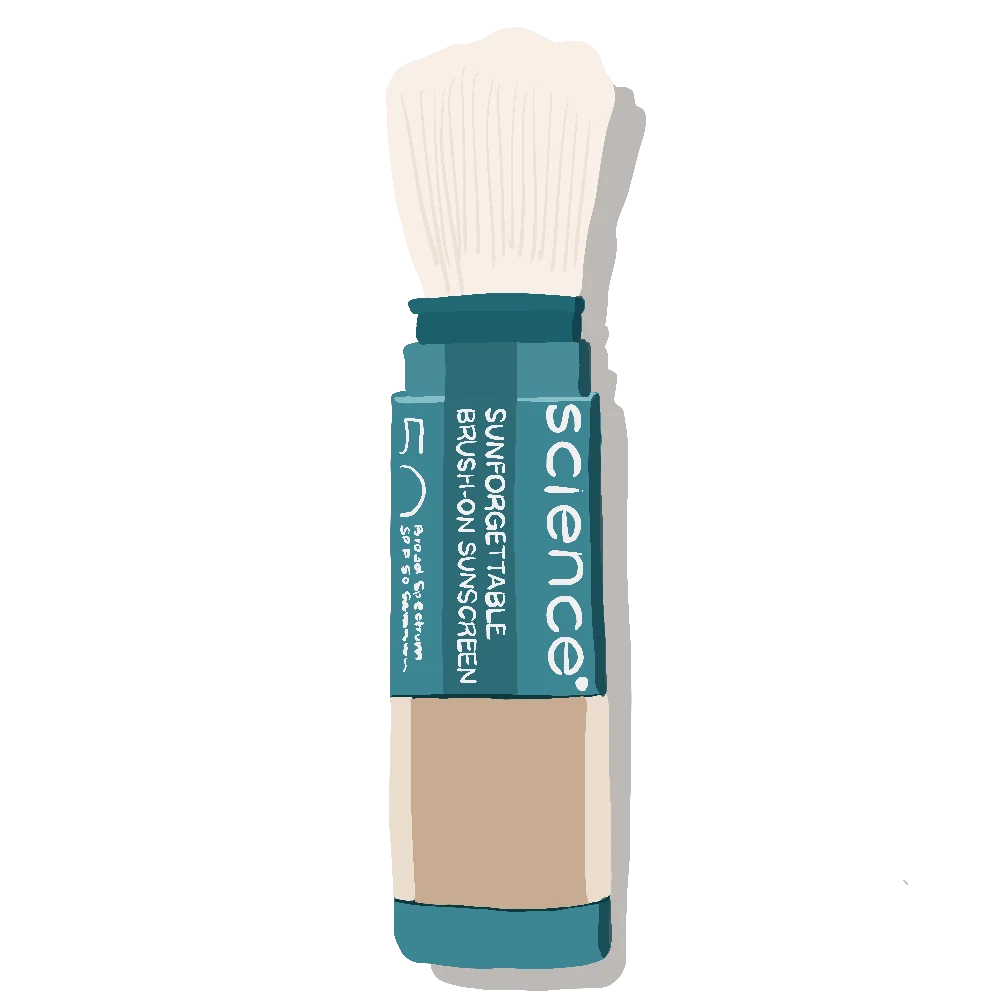
Pro tip: the brush-on format works beautifully along your part line for scalp protection on exposed skin. We carry the Colorescience Sunforgettable Total Protection Brush-on Shield in a range of shades at all four of our Northern California locations.
If you pick the right formula, yes. A matte-finish sunscreen creates a smooth, oil-controlling base under makeup. For many skin types, it replaces a separate primer entirely. What matters is whether the formula uses silica, zinc, or other mattifying agents to absorb surface oils. Not every sunscreen does this.
The Obagi Sun Shield Matte Broad Spectrum SPF 50 is the one we reach for here. It has a non-migrating, matte finish that functions as a primer base and stays in place during physical activity and heat. If you have ever had a sunscreen end up in your eyes by noon, you understand the appeal. When you find a formula that protects, primes, and stays put all day, you have found your sunscreen soulmate. The Obagi Sun Shield Matte is available at all Esthetics Center locations.
White cast happens because mineral UV filters are, by nature, white. Zinc oxide and titanium dioxide sit on the skin surface. On medium to dark skin tones, those white particles create an ashy or gray finish that does not blend away. Nobody wants to spend their day looking like a friendly ghost. Good formulations solve this.
There are two approaches. The first is tinted mineral sunscreens, which add iron oxide pigments to offset the white color of the mineral particles. The second is nano-particle formulations, which reduce mineral particle size until the filter becomes transparent on the skin. Many products use both strategies at once, and those tend to be the ones that actually perform across a range of skin tones.
We carry several tinted options. The Alastin HydraTint Pro Mineral Broad Spectrum Sunscreen SPF 36 delivers a brightening, glowing tinted finish, per Alastin, and comes in one shade. The EltaMD UV AOX Elements Broad Spectrum SPF 50 is ultra-hydrating with added hyaluronic acid. It comes in one universal tint that works well for most skin tones. Very fair or very deep complexions may want to explore other options.
The Obagi Sun Shield Tint Broad Spectrum SPF 50 comes in Cool and Warm: Warm for yellow, golden, or olive undertones, and Cool for pink and neutral ones.
Single-shade tinted sunscreens do not always read right on deeper skin tones. This is one of the more common complaints we hear, and it is completely valid. These options either offer multiple shades or use tone-adapting technology that adjusts on contact.
The Colorescience Sunforgettable Total Protection Face Shield Flex SPF 50 comes in tone-adapting shades that activate on contact to match your skin. It delivers buildable coverage with a demi-matte finish. The Colorescience Sunforgettable Total Protection Brush-on Shield SPF 50 comes in fair, medium, tan, and deep shades. The powder format counters white cast without any wet-product texture.
The Sunbetter Tone Smart SPF 68 Sunscreen Compact is a tone-adapting pressed compact that adjusts to your individual skin tone on application. It gives buildable, blendable coverage and a finish that does not read gray.
We hear this in almost every acne-focused consultation: "Won't sunscreen break me out?" It is a fair worry. Skipping it, though, creates a bigger problem.
Unprotected UV exposure worsens both active acne and post-inflammatory hyperpigmentation. UV radiation increases inflammation, which prolongs active breakouts. It also darkens the red or brown marks that acne leaves behind, making them harder to fade. Consistent daily sunscreen is essential for acne-prone skin. It is not optional.
What you need is a non-comedogenic formula, meaning one that will not block pores. The EltaMD UV Clear Broad Spectrum SPF 46 is non-comedogenic and fragrance-free. It contains niacinamide (vitamin B3), an ingredient with published evidence supporting skin barrier function and reduction of inflammatory redness. It is one of the most frequently used formulations for acne-prone and sensitive skin types.
If you are on isotretinoin or using prescription acne treatments, please confirm the appropriate sunscreen formulation with your provider at a consultation. The choice matters more when other actives are involved.
We hear this one in every other consultation. And we understand the concern.
The American Academy of Dermatology is clear: the skin cancer risk from unprotected UV exposure outweighs any vitamin D benefit from sun exposure. The AAD recommends getting vitamin D from diet and supplementation, not from unprotected sun.
You have plenty of options. Fatty fish like salmon, tuna, and swordfish are good sources. So are eggs, fortified dairy, fortified orange juice, and over-the-counter vitamin D supplements. Daily sunscreen and adequate vitamin D levels are not in conflict. They coexist fine.
If you have a known vitamin D deficiency or you are on medications that affect vitamin D metabolism, talk to your physician about supplementation. That conversation belongs with your doctor, not your sunscreen routine.
Sunscreen significantly reduces UV exposure. It does not eliminate it.
Even SPF 100 allows approximately 1% of UVB rays through. At realistic SPF levels and typical application amounts, some UV still reaches your skin. You can tan with sunscreen on. Just much less so, and much more safely.
If you want color without any UV exposure, sunless tanners are the answer. Yes, this is really how it works. They deposit dihydroxyacetone (DHA) on the skin surface to produce a temporary tan appearance without any radiation involved. One note: if you are using topical retinoids, AHAs, or BHAs, check with your provider before adding a DHA-based self-tanner. Those actives can affect how DHA is processed on the skin.
Bonus tip: Colorescience makes sunscreens with bronzer built in, for both face and body. For a minimal-makeup day, here is a routine we love. Apply a tinted sunscreen as your base. Use the Colorescience Sunforgettable bronzer sunscreen for contour. Finish with the Colorescience Sunforgettable Glow version for a touch of luminosity. Sun protection and a bronzed finish, all at once.
Sunscreen pills when product layers have not fully absorbed before the next one goes on. The friction between those unabsorbed layers creates the little rolls that nobody wants under their foundation.
The causes are almost always one of three things. The first is layering too quickly: each skincare step needs 30 to 60 seconds to absorb before the next product goes on. The second is congested skin, where surface buildup prevents absorption.
Exfoliating gently two to three times per week helps clear the way. If you are using prescription retinoids, AHAs, or BHAs, check with your provider before adjusting your frequency. The same applies if you have recently had a professional treatment. Those actives are already doing that job. The third cause is ingredient incompatibility: some silicone-based products simply do not layer well together.
For chemical sunscreens, pilling is not just a cosmetic problem. If the formula cannot absorb, the UV-filtering actives cannot work at the labeled efficacy. The protection level on the bottle is not what is reaching your skin.
Chemical sunscreens go on before moisturizer because the active ingredients need direct skin contact to absorb. Mineral sunscreens go on after moisturizer because they sit on the skin surface rather than absorbing into it. When in doubt, any order is better than skipping it.
No. Foundation and cosmetics with SPF are rarely applied at the density needed to hit the labeled SPF rating, and they wear off throughout the day. Use a dedicated sunscreen under your makeup. Treat any SPF in cosmetics as supplemental protection only.
Use a brush-on mineral powder sunscreen. The Colorescience Sunforgettable Total Protection Brush-on Shield SPF 50 applies directly over foundation without disturbing it. The AAD recommends reapplying every two hours during sun exposure, or after swimming or sweating.
White cast is caused by zinc oxide and titanium dioxide particles remaining visible on the skin surface. On medium to deep skin tones, those particles produce an ashy or gray finish. Tinted mineral sunscreens with iron oxide pigments and nano-particle formulations both address white cast while maintaining mineral UV protection.
Yes. Non-comedogenic, oil-free sunscreens do not block pores and are appropriate for acne-prone skin. Skipping sunscreen leaves acne-prone skin exposed to UV-induced inflammation, which prolongs breakouts, and to UV darkening of post-inflammatory marks. Check with your provider to confirm the right formulation for your skin type and any prescription treatments you are using.
The American Academy of Dermatology recommends getting vitamin D from diet and supplements, not unprotected sun. The skin cancer risk from UV exposure outweighs the vitamin D benefit. Daily sunscreen and adequate vitamin D levels are not mutually exclusive. If you have a documented deficiency, discuss supplementation with your physician.
Esthetics Center carries a selection of clinical-grade sunscreens at all four Northern California locations. Providers can recommend the right formulation based on your skin type, tone, and daily routine.
Find your nearest location:
Call (916) 941-9400.


